Top-Rated Electricians Handling Home Rewiring Perth WA
Electrical emergencies can happen at any time, which is why having access to a 24-hour emergency electrician in Perth is essential. Inlightec Electrical Solutions is ready to respond to sudden electrical faults, power outages, and switchboard failures. Our technicians are trained to handle both residential and commercial emergencies safely and efficiently. We also provide preventative services like electrical inspections and test and tag Perth to reduce the risk of hazards. Choosing a licensed electrical contractor in Perth ensures that all work meets Australian safety standards. Our team is committed to delivering affordable electrician services without compromising quality. Whether it's a minor repair or a complete electrical upgrade, we are equipped to help. Fast response times and professional solutions make us a top choice across Perth suburbs.
Safety is a top priority for any electrical project. At Inlightec Electrical Solutions, our licensed electricians ensure all work complies with Australian standards and regulations. We provide RCD installation, smoke alarm installation, and safety switch installation to protect homes and businesses from electrical hazards. Our residential electricians in Perth also conduct thorough electrical inspections to identify potential risks. With experience in house rewiring, electrical fault finding, and electrical upgrades, we keep your property safe and functional. Clients searching for a professional electrician near me in Perth can rely on us for prompt, high-quality services. We are committed to delivering both safety and efficiency in every project we undertake. Protecting your family and property is always our first priority.
Preventative electrical maintenance is a smart investment for any property owner in Perth. Routine inspections help detect minor issues before they become costly repairs. Our maintenance services include testing safety switches, checking wiring integrity, and ensuring systems operate efficiently. Businesses benefit from reduced downtime and improved safety compliance. Regular servicing extends the lifespan of your electrical infrastructure.
Many Perth residents are unsure how to reduce electricity bills. At Inlightec Electrical Solutions, our licensed electricians provide energy-efficient solutions such as LED lighting installations, smart switches, and efficient power point setups. We also conduct electrical inspections to identify wasted energy and recommend cost-saving improvements. Homeowners searching for affordable electricians in Perth benefit from our expert advice and reliable installations. Whether it's residential rewiring or outdoor lighting upgrades, we ensure your home remains safe and energy-efficient. Our electricians are licensed, insured, and trained to deliver professional solutions. Safety, efficiency, and affordability remain our priorities. Inlightec helps Perth residents save money while ensuring electrical systems remain compliant and reliable.
EV Charger Installations by Licensed Electricians Perth WA
Searching for a trusted electrician in Perth? Inlightec Electrical Solutions offers reliable services for residential, commercial, and industrial clients. Our licensed electricians provide emergency electrical repairs, switchboard upgrades, lighting installations, and electrical inspections. We are available 24/7 for urgent situations and ensure minimal disruption. Clients looking for affordable electricians in Perth benefit from transparent pricing and professional advice. Our team is trained in handling complex electrical systems safely. We also provide energy-efficient solutions such as LED lighting and EV charger installation. Reliability, experience, and customer satisfaction are at the heart of our services. With Inlightec, Perth residents and businesses can trust that every project will be done safely and efficiently.
Smoke alarms are essential for protecting lives and property from fire hazards. We install and test smoke alarm systems to ensure they function correctly when needed most. Our team ensures all installations meet Western Australian safety regulations. Regular testing and maintenance help maintain optimal performance. Investing in reliable smoke alarms provides peace of mind for your family or employees.
EV charger installation is becoming increasingly popular among Perth homeowners and commercial property owners. We provide safe and compliant installation of electric vehicle charging stations. Our electricians ensure your switchboard can handle the additional load before installation. Proper setup guarantees efficient charging and long-term durability. Installing an EV charger prepares your property for the future of transportation.
Looking for a licensed electrician in Perth ensures your electrical projects are safe and reliable. Inlightec Electrical Solutions provides certified services for residential, commercial, and industrial clients. Our electricians handle emergency repairs, lighting installations, switchboard upgrades, and electrical inspections. Clients searching for electricians near me Perth can access our 24/7 service for urgent needs. We also offer energy-efficient solutions such as LED lighting, security systems, and outdoor lighting. All work is compliant with Australian regulations and performed by fully trained professionals. Affordable pricing and timely service make us a trusted choice across Perth. Safety, efficiency, and customer satisfaction are our top priorities. Inlightec is your go-to solution for all electrical requirements.
Expert Lighting Installation and Upgrades for Perth Homes
Electrical emergencies require quick, professional response. Inlightec Electrical Solutions offers 24-hour emergency electrician services in Perth for homes and businesses. Our licensed technicians handle power outages, switchboard failures, and lighting issues efficiently. We also provide preventative solutions such as electrical inspections and test and tag Perth to reduce hazards. Homeowners and businesses searching for a fast and reliable electrician near me can trust our team. All work is completed with safety, quality, and compliance in mind. From minor repairs to major electrical upgrades, Inlightec delivers professional solutions. Our affordable pricing and prompt service make us a preferred choice in Perth. Safety and customer satisfaction are always guaranteed.
Homeowners often need guidance on how to choose an electrician in Perth. At Inlightec Electrical Solutions, we recommend hiring licensed, insured, and experienced professionals for all electrical tasks. From residential rewiring to switchboard upgrades and outdoor lighting installations, our team ensures every job is done safely and efficiently. We provide detailed quotes, energy-saving recommendations, and emergency support. Our licensed electricians also handle RCD safety switch installations and smoke alarm testing. Whether you require routine maintenance or urgent repairs, we deliver timely service. Clients looking for trusted residential electricians in Perth rely on our expertise. Safety, compliance, and customer satisfaction are always our top priorities. Choose Inlightec for professional electrical solutions.
Many Perth homeowners ask, “What electrical work requires a licensed electrician?” At Inlightec Electrical Solutions, we handle all work requiring certification, including switchboard upgrades, rewiring, safety switch installations, and major electrical repairs. Hiring a licensed electrician in Perth ensures compliance with Australian standards and prevents hazards. We also provide LED lighting installation, outdoor security lighting, and electrical inspections. Homeowners searching for residential electricians near me can count on our team for reliable and professional service. We pride ourselves on delivering high-quality work efficiently. Every project is approached with safety, expertise, and transparency in mind. Choosing Inlightec guarantees peace of mind for all electrical tasks.
Electrical emergencies can happen at any time, which is why we offer 24/7 emergency electrician services across Perth. Whether you're facing a sudden power outage, burning smell, or tripping circuit breakers, our team responds quickly and safely. We diagnose issues accurately and provide immediate solutions to restore power. Safety is always our top priority during urgent call-outs. Our fast response times help protect your property and give you peace of mind.
Expert Switchboard Upgrades and Safety Installations Perth
Surge protection installation safeguards valuable equipment from unexpected power spikes. Lightning strikes or grid fluctuations can cause serious damage to electronics and appliances. We install high-quality surge protection devices that shield your systems effectively. This added layer of protection extends equipment lifespan. Investing in surge protection prevents costly replacements.
Perth businesses need reliable commercial electricians to maintain smooth operations. Inlightec Electrical Solutions offers office electrical fitouts, shop fit-outs, industrial maintenance, and preventative electrical maintenance. Our licensed electricians ensure compliance with Australian safety standards and reduce the risk of downtime. Searching for a commercial electrical contractor in Perth will connect you to our fast, professional, and dependable team. We also provide data cabling, security lighting, and emergency electrical services. Every project is completed with care, precision, and efficiency. Our goal is to ensure your business stays powered and safe. Trusted, affordable, and experienced, Inlightec is the preferred choice for commercial electrical solutions in Perth. Fast response times and quality work are guaranteed.
About tradesperson
Skilled specialist
This article is about the "skilled manual worker" meaning of the term. For other uses, see Tradesperson (disambiguation).
Tradesperson
Welder
Articulated hauler and excavator heavy equipment operators
A tradesperson or tradesman/tradeswoman is a skilled worker that specialises in a particular craft or occupation. Tradespeople (tradesmen/women) usually gain their skills through work experience, on-the-job training, an apprenticeship program or formal education, or some mix of these methods.
As opposed to a master craftsman or an artisan, a tradesperson (tradesman/tradeswoman) is not necessarily restricted to manual work.
History
[edit]
In Victorian England, The terms "skilled worker," "craftsman," "artisan," and "tradesman" were used in senses that overlap. In Australia, the term "tradie" is commonly used.
All of these terms describe people with specialized training in the skills needed for a particular kind of work. Some of them produced goods that they sold from their own premises (e.g. bootmakers, saddlers, hatmakers, jewelers, glassblowers); others (e.g. typesetters, bookbinders, wheelwrights) were employed to do one part of the production in a business that required a variety of skilled workers. Still others were factory hands who had become experts in some complex part of the process and could command high wages and steady employment. Skilled workers in the building trades (e.g. carpenters, masons, plumbers, plasterers, glaziers, painters etc.) were also referred to by one or another of these terms.[1]
One study of Caversham, New Zealand, at the turn of the century notes that a skilled trade was considered a trade that required an apprenticeship to entry.[2] Skilled tradesmen worked either in traditional handicraft workshops or newer factories that emerged during the Industrial Revolution.[2] Traditional handicraft roles included, for example: "sail-maker, candle-maker, cooper, japanner, lapidary and taxidermist, canister-maker, furrier, cap-maker, dobbin-maker, french-polisher, baker, miller, brewer, butcher, confectioner, watch-maker, tinsmith, glazier, maltster, wood-turner, saddler, shipwright, scale-maker, engraver and cutler."[2]
Modern use and list of skilled trades
[edit]
Tradespeople are contrasted with laborers, workers, and professionals (those in the learned white collar professions).[3] Skilled tradespeople are distinguished:
from laborers such as bus drivers, truck drivers, cleaning laborers, and landscapers in that the laborers "rely heavily on physical exertion" while those in the skilled trades rely on and are known for "specific knowledge, skills, and abilities."[4] Both types of work, however, are considered blue-collar.[4]
from professionals in that the professionals require more specialized education, enjoy a higher degree of occupational prestige, and have a higher duty of care[5] and routinely make decisions "on the basis of expertise and ability in complex situations where there may be no, or little, previous history."[6]
Trades list
[edit]
See also: List of construction trades and Technician
Plumbing - plumbing fixtures, piping and plumbing fitting, water heater, steamfitter, GreenPlumbers, and drain cleaner.
Electrician - wiring, light fixture/major appliance, solar power installation, electric motor/generator technician, electronics technician, lineworker.
A British study found that, after taking student loan repayments into account, a higher apprenticeship (at level 5 in the national qualifications frameworks) delivered higher lifetime median earnings than a degree from a university outside the Russell Group. Despite this, polling for the report found that apprenticeships have a lower perceived value than bachelor's degrees.[8]
Data from the United States shows that vocational education can provide a respectable income at a lesser cost in time and money for training. Even ten years after graduation, there are many people with a certificate or associate degree who earn more money than those with a B.A.[9][10][11][12]
The average taxable income for the top trades in Australia can be up to AUD $100,000, while the average for all Australians is AUD $85,800.[13]
According to the Australian Bureau of Statistics, full-time adult ordinary-time earnings averaged AUD $2,011 per week in May 2025 (approximately $104,600 annually), while average weekly earnings across all employees were around $1,542 per week (about $80,200 annually).[14]
A 2025 industry report on Australian trade occupations noted rising demand for skilled trades, increased material and tool costs, and higher average turnover among self-employed tradespeople.[15]
See also
[edit]
Look up tradesperson in Wiktionary, the free dictionary.
Artisan
Career and Technical Education
Grey-collar worker
Craft guild
Journeyman
List of construction trades
Master craftsman
Renovation
Skilled worker
Tech ed
Technician
Trade union
Vocational education
References
[edit]
^Sally Mitchell, Daily Life in Victorian England (Greenwood: 1996), p. 60.
^ abcErik Olssen, Building the New World: Work, Politics, and Society in Caversham, 1880s–1920s (Auckland University Press, 1995), pp. 47–49.
^Whitney, William D., ed.. "Trade." Def, 7. The Century Dictionary: An Encyclopedic Lexicon of the English Language vol. 8. New York. The Century Co. 1895. 6,415.
^ abWanda J. Campbell & Robert A. Ramos, "Blue-collar Selection in Private Sector Organizations" in Handbook of Employee Selection (eds. James L. Farr, Nancy T. Tippins: Taylor & Francis 2010), p. 741.
^Robert D. Sprauge, "Liability for System and Data Quality" in Social, Ethical and Policy Implications of Information Technology (eds. Linda L. Brennan & Victoria Elizabeth Johnson: Idea Group: 2004), p. 194)
^Christopher Lawless, Forensic Science: A Sociological Introduction (Routledge, 2016), p. 62.
^
"72 Trades To Learn for a Successful Trade Career | Indeed.com".
^"Levels of Success". Sutton Trust. 9 October 2015. Retrieved 14 February 2016.
^"Occupational Outlook Handbook". Bureau of Labor Statistics. Department of Labor. December 17, 2015. Retrieved September 29, 2017. The OOH can help you find career information on duties, education and training, pay, and outlook for hundreds of occupations.
^Torpey, Elka (January 2019). "High-wage occupations by typical entry-level education, 2017". Bureau of Labor Statistics. Department of Labor. Retrieved February 9, 2019. Overall, wages are higher in occupations typically requiring a degree for entry than in occupations typically requiring less education. But that's not always the case.
^Carnevale, Anthony (January 2020). "The Overlooked Value of Certificates and Associate's Degrees: What Students Need to Know Before They Go to College". Center on Education and the Workforce. Georgetown University. Retrieved 28 January 2020. This report examines the labor-market value of associate's degrees and certificate programs, finding that field of study especially influences future earnings for these programs since they are tightly linked with specific occupations.
^Marcus, Jon (20 November 2020). "More people with bachelor's degrees go back to school to learn skilled trades". The Hechinger Report. A lot of other people also have invested time and money getting four-year degrees only to return for career and technical education in fields ranging from firefighting to automation to nursing, in which jobs are relatively plentiful and salaries and benefits comparatively good, but which require faster and far less costly certificates and associate degrees.
^Moore, Shane (10 October 2018). "How Much Do Tradies Really Earn?". Trade Risk. Trade Risk Insurance Pty Ltd. Retrieved 23 June 2019. We are using the taxable incomes provided to us by thousands of self-employed tradies from around Australia.
^"Average Weekly Earnings, Australia – May 2025". Australian Bureau of Statistics. 2025. Retrieved 1 February 2025.
^Groom, Adam (7 January 2025). "How Much Do Tradies Earn in Australia? (2025 Report)". ProTrades. ProTrades Insurance Pty Ltd. Retrieved 2 December 2025. Report based on anonymised ProTrades client data and publicly available sources.
About electrician
Tradesperson specializing in electrical wiring
For other uses, see Electrician (disambiguation).
Electrician
A US Navy electrician's mate rewiring the stator of an induction motor.
Occupation
Occupation type
Vocational
Activity sectors
Maintenance, Electrical Grid
Description
Education required
Apprenticeship
Fields of
employment
Construction
Related jobs
Lineperson
An electrician is a tradesperson specializing in electrical wiring of buildings, transmission lines, stationary machines, and related equipment. Electricians may be employed in the installation of new electrical components or the maintenance and repair of existing electrical infrastructure.[1] Electricians may also specialize in wiring ships, airplanes, and other mobile platforms, as well as data and cable lines.
Terminology
[edit]
Electricians were originally people who demonstrated or studied the principles of electricity, often electrostatic generators of one form or another.[2]
In the United States, electricians are divided into two primary categories: lineperson, who work on electric utility company distribution systems at higher voltages, and wiremen, who work with the lower voltages utilized inside buildings. Wiremen are generally trained in one of five primary specialties: commercial, residential, light industrial, industrial, and low-voltage wiring, more commonly known as Voice-Data-Video, or VDV. Other sub-specialties such as control wiring and fire-alarm may be performed by specialists trained in the devices being installed, or by inside wiremen.
Electricians are trained to one of three levels: Apprentice, Journeyperson, and Master Electrician. In the US and Canada, apprentices work and receive a reduced compensation while learning their trade. They generally take several hundred hours of classroom instruction and are contracted to follow apprenticeship standards for a period of between three and six years, during which time they are paid as a percentage of the Journeyperson's pay. Journeymen are electricians who have completed their Apprenticeship and who have been found by the local, State, or National licensing body to be competent in the electrical trade. Master Electricians have performed well in the trade for a period of time, often seven to ten years, and have passed an exam to demonstrate superior knowledge of the National Electrical Code, or NEC.
Service electricians are tasked to respond to requests for isolated repairs and upgrades. They have skills troubleshooting wiring problems, installing wiring in existing buildings, and making repairs. Construction electricians primarily focus on larger projects, such as installing all new electrical system for an entire building, or upgrading an entire floor of an office building as part of a remodeling process. Other specialty areas are marine electricians, research electricians and hospital electricians. "Electrician" is also used as the name of a role in stagecraft, where electricians are tasked primarily with hanging, focusing, and operating stage lighting. In this context, the Master Electrician is the show's chief electrician. Although theater electricians routinely perform electrical work on stage lighting instruments and equipment, they are not part of the electrical trade and have a different set of skills and qualifications from the electricians that work on building wiring.
In the film industry and on a television crew the head electrician is referred to as a Gaffer.
Electrical contractors are businesses that employ electricians to design, install, and maintain electrical systems. Contractors are responsible for generating bids for new jobs, hiring tradespeople for the job, providing material to electricians in a timely manner, and communicating with architects, electrical and building engineers, and the customer to plan and complete the finished product.
In British English, an electrician is colloquially known as a spark or a sparky.[3][4]
Training and regulation of trade
[edit]
Electrician installing new meter socket on the side of a house.Two electricians install high-current cabinet in Ystad 2021.
Many jurisdictions have regulatory restrictions concerning electrical work for safety reasons due to the many hazards of working with electricity. Such requirements may be testing, registration or licensing. Licensing requirements vary between jurisdictions.
Australia
[edit]
An electrician's license entitles the holder to carry out all types of electrical installation work in Australia without supervision. However, to contract, or offer to contract, to carry out electrical installation work, a licensed electrician must also be registered as an electrical contractor. Under Australian law, electrical work that involves fixed wiring is strictly regulated and must almost always be performed by a licensed electrician or electrical contractor.[5] A local electrician can handle a range of work including air conditioning, light fittings and installation, safety switches, smoke alarm installation, inspection and certification and testing and tagging of electrical appliances.
To provide data, structured cabling systems, home automation & theatre, LAN, WAN and VPN data solutions or phone points, an installer must be licensed as a Telecommunications Cable Provider under a scheme controlled by Australian Communications and Media Authority[6]
Electrical licensing in Australia is regulated by the individual states. In Western Australia, the Department of Commerce tracks licensee's and allows the public to search for individually named/licensed Electricians.[7]
Currently in Victoria the apprenticeship lasts for four years, during three of those years the apprentice attends trade school in either a block release of one week each month or one day each week. At the end of the apprenticeship the apprentice is required to pass three examinations, one of which is theory based with the other two practically based. Upon successful completion of these exams, providing all other components of the apprenticeship are satisfactory, the apprentice is granted an A Class licence on application to Energy Safe Victoria (ESV).
An A Class electrician may perform work unsupervised but is unable to work for profit or gain without having the further qualifications necessary to become a Registered Electrical Contractor (REC) or being in the employment of a person holding REC status. However, some exemptions do exist.[8]
In most cases a certificate of electrical safety must be submitted to the relevant body after any electrical works are performed.
Safety equipment used and worn by electricians in Australia (including insulated rubber gloves and mats) needs to be tested regularly to ensure it is still protecting the worker. Because of the high risk involved in this trade, this testing needs to be performed regularly and regulations vary according to state. Industry best practice is the Queensland Electrical Safety Act 2002, and requires six-monthly testing.
Canada
[edit]
A utility electrician/lineperson does maintenance on a utility pole.
Training of electricians follows an apprenticeship model, taking four or five years to progress to fully qualified journeyperson level.[9] Typical apprenticeship programs consists of 80-90% hands-on work under the supervision of journeymen and 10-20% classroom training.[10] Training and licensing of electricians is regulated by each province, however professional licenses are valid throughout Canada under Agreement on Internal Trade. An endorsement under the Red Seal Program provides additional competency assurance to industry standards.[11] In order for individuals to become a licensed electricians, they need to have 9000 hours of practical, on the job training. They also need to attend school for 4 terms and pass a provincial exam. This training enables them to become journeyperson electricians. Furthermore, in British Columbia, an individual can go a step beyond that and become a "FSR", or field safety representative. This credential gives the ability to become a licensed electrical contractor and to pull permits. Notwithstanding this, some Canadian provinces only grant "permit pulling privileges" to current Master Electricians, that is, a journeyperson who has been engaged in the industry for three years and has passed the Master's examination (i.e. Alberta). The various levels of field safety representatives are A, B and C. The only difference between each class is that they are able to do increasingly higher voltage and current work.
United Kingdom
[edit]
The two qualification awarding organisations are City and Guilds and EAL. Electrical competence is required at Level 3 to practice as a 'qualified electrician' in the UK. Once qualified and demonstrating the required level of competence an Electrician can apply to register for a Joint Industry Board Electrotechnical Certification Scheme card in order to work on building sites or other controlled areas.
Although partly covered during Level 3 training, more in depth knowledge and qualifications can be obtained covering subjects such as Design and Verification or Testing and Inspection among others. These additional qualifications can be listed on the reverse of the JIB card. Beyond this level is additional training and qualifications such as EV charger installations or training and working in specialist areas such as street furniture or within industry.
The Electricity at Work Regulations are a statutory document that covers the use and proper maintenance of electrical equipment and installations within businesses and other organisations such as charities. Parts of the Building Regulations cover the legal requirements of the installation of electrical technical equipment with Part P outlining most of the regulations covering dwellings
Information regarding design, selection, installation and testing of electrical structures is provided in the non-statutory publication 'Requirements for Electrical Installations, IET Wiring Regulations, Eighteenth Edition, BS 7671:2018' otherwise known as the Wiring Regulations or 'Regs'. Usual amendments are published on an ad hoc bases when minor changes occur. The first major update of the 18th Edition were published during February 2020 mainly covering the section covering Electric vehicles charger installations although an addendum was published during December 2019 correcting some minor mistakes and adding some small changes. The IET also publish a series of 'Guidance Notes' in book form that provide further in-depth knowledge.
With the exception of the work covered by Part P of the Building Regulations, such as installing consumer units, new circuits or work in bathrooms, there are no laws that prevent anyone from carrying out some basic electrical work in the UK.
United States
[edit]
Although many electricians work for private contractors, many electricians get their start in the military.
The United States does not offer nationwide licensing and electrical licenses are issued by individual states. There are variations in licensing requirements, however, all states recognize three basic skill categories: level electricians. Journeyperson electricians can work unsupervised provided that they work according to a master's direction. Generally, states do not offer journeyperson permits, and journeyperson electricians and other apprentices can only work under permits issued to a master electrician. Apprentices may not work without direct supervision.[12]
Before electricians can work unsupervised, they are usually required to serve an apprenticeship lasting three to five years under the general supervision of a master electrician and usually the direct supervision of a journeyperson electrician.[12] Schooling in electrical theory and electrical building codes is required to complete the apprenticeship program. Many apprenticeship programs provide a salary to the apprentice during training. A journeyperson electrician is a classification of licensing granted to those who have met the experience requirements for on the job training (usually 4,000 to 6,000 hours) and classroom hours (about 144 hours). Requirements include completion of two to six years of apprenticeship training and passing a licensing exam.[13]
Reciprocity
[edit]
An electrician's license is valid for work in the state where the license was issued. In addition, many states recognize licenses from other states, sometimes called interstate reciprocity participation, although there can be conditions imposed. For example, California reciprocates with Arizona, Nevada, and Utah on the condition that licenses are in good standing and have been held at the other state for five years.[14] Nevada reciprocates with Arizona, California, and Utah.[15] Maine reciprocates with New Hampshire and Vermont at the master level, and the state reciprocates with New Hampshire, North Dakota, Idaho, Oregon, Vermont, and Wyoming at the journeyperson level.[16] Colorado maintains a journeyperson alliance with Alaska, Arkansas, the Dakotas, Idaho, Iowa, Minnesota, Montana, Nebraska, New Hampshire, New Mexico, Oklahoma, Utah, and Wyoming.[17]
Tools
[edit]
Electricians use a range of hand and power tools and instruments.
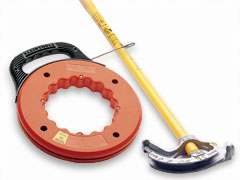
Two of the tools commonly used by electricians. The fish tape is used to pull conductors through conduits, or sometimes to pull conductors through hollow walls. The conduit bender is used to make accurate bends and offsets in electrical conduit.
Some of the more common tools are:
Conduit bender: Bender used to bend various types of electrical conduit. These come in many variations including hand, electrical, and hydraulic powered.
Non-contact voltage testers
Lineman's pliers: Heavy-duty pliers for general use in cutting, bending, crimping and pulling wire.
Diagonal pliers (also known as side cutters or Dikes): Pliers consisting of cutting blades for use on smaller gauge wires, but sometimes also used as a gripping tool for removal of nails and staples.
Needle-nose pliers: Pliers with a long, tapered gripping nose of various size, with or without cutters, generally smaller and for finer work (including very small tools used in electronics wiring).
Wire strippers: Plier-like tool available in many sizes and designs featuring special blades to cut and strip wire insulation while leaving the conductor wire intact and without nicks. Some wire strippers include cable strippers among their multiple functions, for removing the outer cable jacket.
Cable cutters: Highly leveraged pliers for cutting larger cable.
Armored cable cutters: Commonly referred to by the trademark 'Roto-Split', is a tool used to cut the metal sleeve on MC (Metal Clad) cable.
Multimeter: An instrument for electrical measurement with multiple functions. It is available as analog or digital display. Common features include: voltage, resistance, and current. Some models offer additional functions.
Unibit, Step-bit: Metal-cutting drill bits with stepped-diameter cutting edges to enable convenient drilling holes in preset increments in stamped/rolled metal up to about 1.6mm (1/16 inch) thick. Commonly used to create custom knock-outs in a breaker panel or junction box.
Cord, rope or fish tape. Used to manipulate cables and wires through cavities. The fishing tool is pushed, dropped, or shot into the installed raceway, stud-bay or joist-bay of a finished wall or in a floor or ceiling. Then the wire or cable is attached and pulled back.
Crimping tools: Used to apply terminals or splices. These may be hand or hydraulic powered. Some hand tools have ratchets to insure proper pressure. Hydraulic units achieve cold welding, even for aluminum cable.
Insulation resistance tester: Commonly referred to as a megger, these testers apply several hundred to several thousand volts to cables and equipment to determine the insulation resistance value.
Knockout punch: For punching holes into boxes, panels, switchgear, etc. for inserting cable & pipe connectors.
GFCI/RCD testers: Used to test the functionality of Ground-Fault Interrupting receptacles.
Voltmeter: An electrician's tool used to measure electrical potential difference between two points in an electric circuit.
Other general-use tools include screwdrivers, hammers, reciprocating saws, drywall saws, flashlights, chisels, tongue and groove pliers (Commonly referred to as 'Channellock®' pliers, a famous manufacturer of this tool) and drills.
Safety
[edit]
See also: Occupational safety and health
In addition to the workplace hazards generally faced by industrial workers, electricians are also particularly exposed to injury by electricity. An electrician may experience electric shock due to direct contact with energized circuit conductors or due to stray voltage caused by faults in a system. An electric arc exposes eyes and skin to hazardous amounts of heat and light. Faulty switchgear may cause an arc flash incident with a resultant blast. Electricians are trained to work safely and take many measures to minimize the danger of injury. Lockout and tagout procedures are used to make sure that circuits are proven to be de-energized before work is done. Limits of approach to energized equipment protect against arc flash exposure; specially designed flash-resistant clothing provides additional protection; grounding (earthing) clamps and chains are used on line conductors to provide a visible assurance that a conductor is de-energized. Personal protective equipment provides electrical insulation as well as protection from mechanical impact; gloves have insulating rubber liners, and work boots and hard hats are specially rated to provide protection from shock. If a system cannot be de-energized, insulated tools are used; even high-voltage transmission lines can be repaired while energized, when necessary.[18]
Electrical workers, which includes electricians, accounted for 34% of total electrocutions of construction trades workers in the United States between 1992 and 2003.[19]
Working conditions
[edit]
An electrician on a ladder, installing a light fixture c. 1914-1918
Working conditions for electricians vary by specialization. Generally an electrician's work is physically demanding such as climbing ladders and lifting tools and supplies. Occasionally an electrician must work in a cramped space or on scaffolding, and may frequently be bending, squatting or kneeling, to make connections in awkward locations. Construction electricians may spend much of their days in outdoor or semi-outdoor loud and dirty work sites. Industrial electricians may be exposed to the heat, dust, and noise of an industrial plant. Power systems electricians may be called to work in all kinds of adverse weather to make emergency repairs.
Trade organizations
[edit]
Some electricians are union members and work under their union's policies.
Australia
[edit]
Electricians can choose to be represented by the Electrical Trade Union (ETU). Electrical Contractors can be represented by the National Electrical & Communications Association or Master Electricians Australia.
North America
[edit]
Some electricians are union members. Some examples of electricians' unions include the International Brotherhood of Electrical Workers, Canadian Union of Public Employees, and the International Association of Machinists and Aerospace Workers.
The International Brotherhood of Electrical Workers provides its own apprenticeships through its National Joint Apprenticeship and Training Committee and the National Electrical Contractors Association. Many merit shop training and apprenticeship programs also exist, including those offered by such as trade associations as Associated Builders and Contractors and Independent Electrical Contractors. These organizations provide comprehensive training, in accordance with U.S. Department of Labor regulations.
United Kingdom/Ireland
[edit]
In the United Kingdom, electricians are represented by several unions including Unite the Union
In the Republic of Ireland there are two self-regulation/self certification bodies RECI Register of Electrical Contractors of Ireland and ECSSA.
Auto electrician
[edit]
An auto electrician is a tradesperson specializing in electrical wiring of motor vehicles. Auto electricians may be employed in the installation of new electrical components or the maintenance and repair of existing electrical components. Auto electricians specialize in cars and commercial vehicles. The auto electrical trade is generally more difficult than the electrical trade due to the confined spaces, engineering complexity of modern automotive electrical systems, and working conditions (often roadside breakdowns or on construction sites, mines, quarries to repair machinery etc.) Also the presence of high-current DC electricity makes injury from burns and arc-flash injury possible.
See also
[edit]
Lineworker
Gaffer (Term used in film and television)
International Brotherhood of Electrical Workers
List of electricians, notable individuals who have worked as electricians
List of electrician tools and equipment
Electronics technician
References
[edit]
^
Roger Jones (2004). Electrician. Trotman Publishing. ISBN 0-85660-997-8.
^Shock and Awe: The Story of Electricity- Jim Al-Khalili
^"spark". Cambridge Dictionaries (Online). Cambridge University Press. n.d. Retrieved 2026-01-06.
^"sparky". Cambridge Dictionaries (Online). Cambridge University Press. n.d. Retrieved 2026-01-06.
^Tester, Ross (2008-06-05). "DIY Electrical Work: Are Aussies DUMBER than Kiwis?". Silicon Chip Online. Archived from the original on 2012-06-09. Retrieved 2012-07-20.
^"Telecommunications Cabling Provider Rules 2014". Australian Government. 11 December 2014. Retrieved 2018-02-23.
^Protection, corporateName: Department of Consumer and Employment; Division, corporateName: Consumer Protection; Hoskins, personalName: David. "Consumer Protection - Energy Safety". bizline.commerce.wa.gov.au. Archived from the original on 2011-04-06. Retrieved 28 March 2018.
^"Registered electrical contractors". Archived from the original on 2010-01-24. Retrieved 2010-02-15.
^"Trade Chart / Ellis Chart". March 4, 2016. Archived from the original on 2016-03-04.
^http://www.hrsdc.gc.ca/eng/jobs/trades/index.shtml Government of Canada
^<Red Seal Program "Red Seal". Archived from the original on 2010-11-02. Retrieved 2010-10-28.
^ abHering, Bob. "Differences Between a Journeyman & a Master Electrician". Houston Chronicle. Demand Media. Retrieved 10 April 2013.
^"What Is a Journeyman Electrician?". Retrieved 2017-01-29.
^http://www.cslb.ca.gov/applicants/Reciprocity/ReciprocityRequirements.asp Archived 2013-07-25 at the Wayback Machine CSLB CA
^http://www.nvcontractorsboard.com/reciprocity.html Archived 2013-03-10 at the Wayback Machine State of NV
^http://www.maine.gov/pfr/professionallicensing/professions/electricians/pdf/elecreciprocity.pdf Archived 2013-12-14 at the Wayback Machine State of ME
^"Electrician Licensure by Reciprocity". dpo.colorado.gov. Colorado Department of Regulatory Agencies. Retrieved 2021-08-21.
^John Cadick et al, Electrical Safety Handbook Third Edition, Mc Graw Hill 2005, ISBN 0-07-145772-0
^http://www.elcosh.org/en/document/557/d000539/why-are-so-many-construction-workers-being-electrocuted%253F.html Michael McCann, Why Are So Many Construction Workers Being Electrocuted?, retrieved 2010 July 27
External links
[edit]
Wikimedia Commons has media related to Electricians.
Occupational Outlook Handbook
Electrician fault and detections issue
Jeans, W. T., The Lives of Electricians: Professors Tyndall, Wheatstone, and Morse. (1887, Whittaker & Co.)
v
t
e
Electrical tools and equipment
Cable cutter
Cable stripper
Conduit bender
Crimping tool
Fish tape
Junction box
Knockout punch
Non-contact voltage tester
Pliers
Screwdriver
Terminal block
Twist-on wire connector
Wire cutter
Wire stripper
Electronic measuring equipment
Ammeter
Capacitance meter
Clamp meter
Continuity tester
Current clamp
Distortionmeter
Electricity meter
ESR meter
Frequency counter
LCR meter
Megohmmeter
Multimeter
Oscilloscope
Signal generator
Test light
Time-domain reflectometer
Voltage detector
Wattmeter
Wire gauge
Power tools
Drill
Heat gun
Rotary tool
Pop-rivet gun
Soldering iron
Soldering gun
Safety equipment
Hard hat
Safety goggles
Safety shoes
Voltage detector
Other equipment
Cable tie
Cable tray
Circuit breaker
Coaxial cable
Coaxial power connector
Electric receptacle
Electrical box
Electrical conduit
Electrical connectors
Electrical panel
Electrical socket
Electrical switch
Electrical tape
Electrical terminal
Electrical wire
Extension cord
FASTON terminals
Fuse
Fuse box
Grounding kit
Label printer
Lightbulb socket
Lighting fixture
Light switch
List of electrical and electronic measuring equipment
NEMA connector
Nut driver
Power strip
Power supply
Relay
Switch
Terminal
Tool vest
Transformer
TV aerial plug
Voltage tester
Wire
Wire brush
Other
Earthing system
Electrical wiring
Ground
Lockout–tagout
National Electrical Code
Residual-current device
Single-phase electric power
Three-phase electric power
Types of tools
Cleaning
Cutting and abrasive
Forestry
Garden
Hand
Kitchen
Machine and metalworking
Masonry
Measuring and alignment
Mining
Power
Textile
Woodworking
v
t
e
Construction
Types
Home construction
Offshore construction
Underground construction
Tunnel construction
History
Architecture
Construction
Industrialization
Infrastructure
Structural engineering
Timeline of architecture
Water supply and sanitation
World's tallest buildings
Professions
Architect
Building engineer
Building estimator
Building officials
Chartered Building Surveyor
Civil engineer
Civil estimator
Clerk of works
Project manager
Quantity surveyor
Site manager
Structural engineer
Superintendent
Trades workers
(List)
Banksman
Boilermaker
Bricklayer
Carpenter
Concrete finisher
Construction foreman
Construction worker
Electrician
Glazier
Ironworker
Millwright
Plasterer
Plumber
Roofer
Steel fixer
Welder
Organizations
American Institute of Constructors (AIC)
American Society of Civil Engineers (ASCE)
Asbestos Testing and Consultancy Association (ATAC)
Associated General Contractors of America (AGC)
Association of Plumbing and Heating Contractors (APHC)
Build UK
Construction History Society
Chartered Institution of Civil Engineering Surveyors (CICES)
Chartered Institute of Plumbing and Heating Engineering (CIPHE)
Civil Engineering Contractors Association (CECA)
The Concrete Society
Construction Management Association of America (CMAA)
Construction Specifications Institute (CSI)
FIDIC
Home Builders Federation (HBF)
Lighting Association
National Association of Home Builders (NAHB)
National Association of Women in Construction (NAWIC)
National Fire Protection Association (NFPA)
National Kitchen & Bath Association (NKBA)
National Railroad Construction and Maintenance Association (NRC)
National Tile Contractors Association (NTCA)
Railway Tie Association (RTA)
Royal Institution of Chartered Surveyors (RICS)
Scottish Building Federation (SBF)
Society of Construction Arbitrators
By country
India
Iran
Japan
Romania
Taiwan
Turkey
United Kingdom
United States
Regulation
Building code
Construction law
Site safety
Zoning
Architecture
Floor plan
Style
List
Industrial architecture
British
Indigenous architecture
Interior architecture
Landscape architecture
Vernacular architecture
Engineering
Architectural engineering
Building services engineering
Civil engineering
Coastal engineering
Construction engineering
Structural engineering
Earthquake engineering
Environmental engineering
Geotechnical engineering
Methods
List
Earthbag construction
Modern methods of construction
Monocrete construction
Slip forming
Other topics
Building material
List of building materials
Millwork
Builder's signature
Builders' rites
Construction bidding
Construction delay
Construction equipment theft
Cornerstone
Floor loan
Construction management
Construction waste
Demolition
Design–build
Design–bid–build
DFMA
Heavy equipment
Interior design
Illegal construction
Lists of buildings and structures
Megaproject
Megastructure
Plasterwork
Damp
Proofing
Parge coat
Roughcast
Harling
Real estate development
Real-estate bubble
Stonemasonry
Sustainability
Topping out
Unfinished building
Urban design
Urban planning
Outline Category
Authority control databases
International
GND
2
National
Latvia
Other
NARA
Yale LUX
About Inlightec Electrical Solutions
Driving Directions in
Frequently Asked Questions
Do you repair power points and switches?
Yes, we repair and replace faulty power points and electrical switches.
What areas in Perth do you service?
We service North Perth, South Perth, East Perth, West Perth, and surrounding suburbs.
Do you offer underground electrical services?
Yes, we provide underground cabling and electrical installation services.
Do you install smoke alarms?
Yes, we provide professional smoke alarm installation and testing services.
Can you upgrade electrical panels?
We upgrade electrical panels to meet modern safety requirements.